Monday, September 24, 2012

The Last Temptation of Christ -
Martin Scorsese (1988)

Martin Scorsese has made some pretty decent movies, several of which ended up somewhere on the 2012 Sight & Sound poll. I had originally planned to watch Hugo (2011, S&S #588) early in the month. Didn't get the DVD borrowed, and decided to just roll over to a different film on a different theme.

I crossed protest lines to see this in the theater. Texas, man...


The Last Temptation of Christ
dir. Martin Scorsese. 1988, USA.
Sight & Sound 2012: Critics' #894 (whoa. 1 vote?)
Roger Ebert's Great Movies ... Criterion essay
DVD/Blu-Ray from the Criterion Collection
Watch via Amazon Instant / iTunes / YouTube


The Last Temptation of Christ trailer (1988)

Rabbi 1: That is blasphemy.
Jesus: Didn't they tell you? I am the saint of blasphemy. Don't make any mistakes. I didn't come here to bring peace, I came to bring a sword!
Rabbi 2: Talking like that will get you killed.

Migraines of the reluctant Messiah. Early on, you might wonder whether this will be the Jefferson Christ - maybe a seer of visions, but no miracle-worker. But that's not the case. As much as I think this is a great movie, I do often wish it was somehow different or possibly better. This time around, I noticed how much of the story is comprised of the Greatest Hits by Jesus: water-into-wine, raising Lazarus, storming the money-changers, the Last Supper... Often handled with a deft touch though, sure. Like Judas's crack about Peter being steady and solid as a rock. Or when Jesus he-who-is-without-sin's the stone-casting mob and Zebedee (director of The Empire Strikes Back) steps forward, he calls him out. "Who is that widow you've been seen with?" And someone in the back of the crowd yells out, "Judith!!" Awesome. I also wondered if there were any relation at all to the Bob Dylan "Judas!!" heckler.

The focus is very clearly on the human aspect of the Christ duality: the fear, reluctance, indecision, resentment, confusion, that bearing the Holy Spirit would create. But sometimes it spills over into the realm of possible madness. The way he expects crowds to naturally understand his vague parables, which could easily come off as nutty ramblings. Pretending not to recognize his own mother to make some obscure point. Until the literal miracles start up, the hint of insanity meshes with the earlier doubts among his disciples (especially the guy who misses his sheep). The approval of John the Baptist ("My Dinner with" Andre Gregory) might even be suspect given the throng of ecstatic loons he attracts. But once you see someone pull their own heart out of their chest and start talking baptism-by-fire, you pretty much have proof.


But overall, I generally feel sorry for this Jesus. From what Magdalene says, sounds like he was a pretty normal kid. He admits his faults, and especially his paralyzing fears, to the desert monk early in his journey. Despite those fears, he accepts his duty and pushes forward towards his own death. While waiting for the "betrayal" at Gethsemene, he's scared shitless - begging to be spared like Moses, Isaac, Noah, Elijah... And of course, Satan exploits his fear of death with the last temptation. What kind of bothers me is how Jesus isn't so much tempted to live a whole, normal, happy life - he gets to!! Might not technically be reality, but seems fairly real to me. I'd forgotten that it wasn't actually Magdalene that Jesus grew old with. Also, Harry Dean Stanton's St. Paul is practically satire.

Other than the sacrilege, a common complaint is the various (usually American) accents on display in the holy land - Brooklyn Judas and so on. I don't see the problem. It would be weirder to me if everyone tried to put on the same fake accent, and what would that be? Some American Jewish accent, something like European Yiddish, some Middle Eastern Hebrew flourishes, the flat nowhere diction of Hollywood? No thanks. Also, although they're clearly American accents, the variety might even be kind of accurate - like if the different characters came from different regions within Israel. Willem Dafoe talks like a Nazarene, the Iscariots were the Brooklynites of Judea, etc... Romans of course have spoken with a British accent (Bowie!) since time immemorial.

A lot of great desert photography, nice Peter Gabriel "world music" soundtrack, an all-star cast with lots of odd cameos. It's certainly not perfect, but I do find it thought-provoking. And the filmstrip runout transcendence right before the end credits provides one final unusual touch.

Sunday, September 23, 2012

The Magnificent Ambersons -
Orson Welles (1942)

Here's another one from former top dog on the Sight & Sound poll. It's tragic how many Welles movies I have not seen. O sure, Citizen Kane (1941, S&S #2) and Touch of Evil (1958, S&S #57)... even The Stranger (1946) on a swap-meet bootleg DVD. But he had 10 films total get votes this decade.

Other than Kane and Touch, this is probably his most acclaimed - although Fallstaff/Chimes at Midnight (1966, S&S #154) has been making a surge recently among Wellesologists.


The Magnificent Ambersons
dir. Orson Welles. 1942, USA.
Sight & Sound 2012: Critics' #81 / Directors' #174
New York Times movie review ... Criterion essay
DVD from Amazon
No streaming...


The Magnificent Ambersons trailer (1942)

Major Amberson: It must be the sun. There wasn't anything here but the sun in the first place. Sun... Earth came out of the sun, and we came out of the Earth. So, whatever we are... it must have been the Earth.

Once again, the younger generation is represented by feckless jackasses - well, mainly just the one. And there's another nice young girl too. And like Tokyo Story, we revisit the themes of changing times and urbanization (automobilization?). For some reason, the story was set in motion by a failed serenade attempt and a broken "bass-fiddle." I guess times were different then.

The main young jerk here is George, and townsfolk are wishing for his comeuppance maybe even before he's born. And he almost never becomes anything more than a spoiled brat. I like it when the old movies show characters reacting in realistic ways, and everyone here treats him pretty much like a spoled brat. At one point, I think I actually yelled at the screen, "Quit being such a big baby!!"


A lot of the film recalls the look of Citizen Kane: snowy outdoors, opulent interiors, darker images, deep focus. The stage influence is still strong with this one, including the ensemble acting and lively pace - at least relative to a lot the movies I've watched this month. Things get pretty grim down the stretch, with young George having to sacrifice the law career he never wanted, to take a job in (no joke) a dynamite factory. Whoo... Old men descend into madness, and George's last walk home is almost hallucinatory.

I literally did not understand the ending. It would seem that test audiences didn't like the depressing end, so the studio cut an hour off and cobbled together a happy one while Welles was out of town. George getting both legs broken in an auto-mo-bile accident was quite fitting, although maybe not technically a comeuppance. Then the girl who awesomely rebuffed him takes her dad, who he'd kept from marrying his mother and whom his aunt had also loved, to visit George in the hospital - and so everything's settled. Okay... O yeah, and they also destroyed all the material removed from the original cut, so no-one can put it back together like how they fixed the studio-butchered Touch of Evil.

I guess times were different then.

Saturday, September 22, 2012

Tokyo Story - Yasujirô Ozu (1953)

I'd previously said that I wouldn't be covering the #1 and #2 films from this year's Sight & Sound poll. There's already been so much said (including recently) about both Citizen Kane (1941, #2) and Vertigo (1958, the new #1).

But I never said anything about #3!!


Tokyo Story (Tōkyō Monogatari)
dir. Yasujiro Ozu. 1953, Japan.
Sight & Sound 2012: Critics' #3 / Directors' #1
Roger Ebert's Great Movies ... Criterion essay
DVD from the Criterion Collection
Watch via Amazon Instant / Hulu-Plus / iTunes


Tokyo Story trailer (1953)

Father: Anyway, this place is meant for the younger generation.

Seriously, #1 from directors and #3 on the main list? Check it out. Like a couple of other movies, I'd picked up the dvd back when I first started hearing about the movie, watched it once or maybe twice, and it's been sitting around ever since. So I remember the overall theme and plot points generally, but I think I caught more nuances this time around. Parts of the out-of-town older parents visiting that I remember making me sad on earlier viewings kind of made me more angry this time. The way each younger generation treats the older one is wretched, and the older grandson's spazz-out over a cancelled trip into town is a good metaphor for the whole dynamic.

The onscreen compositions are either meticulous, such as actor placement and the interiors with various squares, vertical and horizontal lines... or lyrical, especially Ozu's famous "pillow shots" of various locales. Ozu had a particular way (not sure if unique) of positioning characters so that they're not facing each other, but all facing the same way in parallel. These scenes are often shot with the characters seated on the floor, with the camera about even with eye level. Anyway, I thought it was interesting when they go on a bus tour of Tokyo, everyone in the bus are all sitting the way Ozu characters usually do. (Also true of train riders...)


The little touches keep giving. After yet another display of heedless behavior (especially from the daughter), the mother stays with kind Noriko. And the father hunts down "Hattori, Professional Scribe" from home, now living in Tokyo. He's renting a room to a hilarious pinball playboy (well, the concept was hilarious to me, the kid barely appears in the movie). And their old police chief has also moved to the big city. The three hook up and go on a righteous sake bender. There's no school like the old school! Things get pretty heavy too, but obviously much better than imposing on kids who've grown away.

As frustrating as it can be, I was glad that everything didn't just work out in the end - no-one necessarily learns anything either. Noriko's long-missing husband doesn't ever show back up. Most of the younger generation are still clueless jerks - one arrives home too late, and basically admits that he could have taken an earlier train. Then when everyone's trying to run off again from their parents', he says he needs to leave to get back for a baseball game! Finally, the conversation between the youngest daughter Kyoko (still living at home) and Noriko works perfectly to put everything in perspective(s). Kyoko isn't wrong about everyone being totally selfish, and the smiling wallflower doormat widow isn't wrong that it's just the way of the world. Anyone who's lived long enough has realized they have treated their own parents thoughtlessly before, but what are you gonna do?

Friday, September 21, 2012

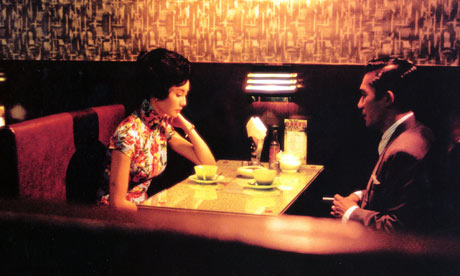
In the Mood for Love - Wong Kar-wai (2000)

Quite the stunner from the 2012 Sight & Sound poll! At least for me... The higher-ranked (of 2) movies from the 2000s.


In the Mood for Love (Fa yeung nin wa)
dir. Wong Kar-wai. 2000, Hong Kong.
Sight & Sound 2012: Critics' #24 / Directors' #67
Roger Ebert's movie review ... Criterion essay
DVD/Blu-Ray from the Criterion Collection
No streaming...


In the Mood for Love trailer (2000)

"She dresses up like that to go out for noodles?!"

Alright. First off, here's a well-made film with several interesting aspects. I've liked Maggie Cheung since back in the '80s during Jackie Chan's HK action heyday, and Tony Leung had a prominent role in John Woo's Hard Boiled (1992). Not that I came in expecting death-defying stunts and double-fisted gunplay. Good period (early-'60s) drama, but unrelentingly sad. And the #24 movie of all time? Regardless of your methodology, I'm not ready to get behind that. Maybe I just wasn't in the mood for In the Mood for Love... Ha! I've got to be the only one to have ever made such a comment.


Perfectly understandable why it's such a major downer. Both of our leads seem like Destiny (as the happy coincidences pile up)... are already chronically abandoned by their mates (whose treatment by the film is just one point of interest)... even before they start to suspect an affair (on which they obsess unto reenactment)... then resisting the obvious course (preemptive strike rehearsal), and foiling Destiny (even unto Cambodia). A little levity comes from the sidelines, but clearly this story of about the sad sacks who get left behind with each other - while their spouses enjoy high adultery together. The style looks great but also appropriate for the tone, and the acting is consistently top-notch, but it clearly could have used more drunken master martial arts storyline. I'll just have to try again later.

This movie is part two in a semi-formal trilogy, including Days of Being Wild (1990, S&S #283) beforehand and 2046 (2004, #447) afterwards. I'm also interested in those, especially the last one.

Thursday, September 20, 2012

Uncle Boonmee Who Can Recall His Past Lives - Apichatpong Weerasethakul (2010)

Although technical issues continue to arise or persist, I still wanted to check out this up-and-coming 2012 Sight & Sound poll inductee - oh, and Palme d'Or winner!

I'm borderline certain this was my first Thai movie...


Uncle Boonmee Who Can Recall His Past Lives
(Loong Boonmee raleuk chat, ลุงบุญมีระลึกชาติ)
dir. Apichatpong Weerasethakul. 2010, Thailand, etc...
Sight & Sound 2012: Critics' #202 / Directors' #132
Roger Ebert's movie review
DVD from Amazon [Blu-Ray]
Watch via Hulu-Plus / Amazon Prime only / iTunes / YouTube


Uncle Boonmee trailer (2010)

By my count, if you want to win the Palme d'Or these days, sprinkle your family drama with some metaphysical mumbo-jumbo.

"Jen: How can you expect me to stay here, with all the ghosts and migrant workers?"

Okay, seriously? This is a wonderful movie. It has family, ghosts, rural Thai farm life, forest spirits, spelunking, beekeeping, renal failure, an electric hand-held bug-zapper, and karaoke. Not as many past lives as I expected, though... I'm not sure which side the film focused more on, because the mundane and supernatural seemed to mesh so easily. The characters all accept the arrival of long-gone wives, sisters and children, with a surprisingly easy-going manner. Wait, are these returning ghosts some of Uncle Boonmee's "past lives" - like in the non-karmic sense of the term - that he has "recalled" - in the non-remembering sense?

The film handles the supernatural stuff well, including the iconic Boonsong the Monkey Ghost. Although not reliant on high-tech SFX, whatever effects are attempted work - resulting in a more dreamy, ethereal mood than anything scary or creepy. One flashback to a past life (?), apparently during the reign of Princess Monkeyface, shows the Wisdom of the Catfish.


I don't believe I fully grasped the last part(s) of the movie. I got the significance of the Primordial Cave, but missed out on the future dream and stylistic switch to slo-mo slide-show. Though I don't like the sound of totalitarian F°451-style military destruction of images. Then there's the monastic coda, TV hypnotism in a hotel room, with a Möbius time-dilation (?), and then some dinner in a loud, garish, colorful restaurant. About the only thing I really 'understood' was that all these final locations all somehow stood in opposition to the past, the forest, the rural, family home places earlier in the movie.

After writing up my posts, I usually review a plot synopsis to make sure I didn't miss anything in my notes. Don't think I've ever added anything significant, but I wanted to include this from Wikipedia: "The film consists of six reels each shot in a different cinematic style. The styles include, by the words of the director, 'old cinema with stiff acting and classical staging', 'documentary style', 'costume drama' and 'my kind of film when you see long takes of animals and people driving'." I most certainly overlooked that!

Highly recommended.

Wednesday, September 19, 2012

The Holy Mountain - Jodorowsky (1973)

I have seen El Topo (1970, S&S #588), and I'd listened to this one's soundtrack (but didn't realize that Don Cherry was part of it), and I knew that John Lennon ponied up some dough for the production.

Produced by Allen Klein, plus rumors of George Harrison almost starring!


The Holy Mountain (La montaña sagrada)
dir. Alexandro Jodorowsky. 1973, USA.
Sight & Sound 2012: Critics' #588 / Directors' #224
Eye for Film movie review ... 366 Weird Movies essay
DVD from Amazon [Blu-Ray / Box-set]
No streaming...


***NSFW*** The Holy Mountain trailer (1973)

Patron: The cross was a mushroom. And the mushroom was also the Tree of Good & Evil. The philosophical stone of the alchemists was LSD. The Book of the Dead is a trip, and The Apocalypse describes a mescaline experience.

Lessee... my notes read: "SHOCKING (images)! NONSENSE (story)!!" Well, maybe not completely. More psychedelic mysticism than traditional surrealism - something to do with the ultimate quest for immortality, ego-death, metempsychosis and/or spiritual ascension. I noticed various symbols of the Tarot, but probably missed a lot and couldn't actually interpret the ones I did see... apparently, the main character was intended as The Fool. Along with some quite disturbing sights, the experience features a lot of fantastical visuals and design. This film definitely looks great, but watch your dosage.


A still from only the post-ritual chanting & shaving credits intro... already. I really can't explain much about the film, so have a bunch of intriguing pix.


Super cover reconstruction from Che cosa sono le nuvole!


Oops, most of these are from the Alchemist's Tower, where transformation occurs. O well, no Aztec horned toads battle, no significant animal trauma, always a lot of Jesuses, one carried by a Christopher, a pack of whores with a chimpanzee in tow (Chucho-Chucho)... and that's just in the first City of Iniquity section of the tripartite structure.


Why yes, primary colors do feature prominently.


Fortunately the exotic animals fare much better than goats, et cetera... I wrote a lot of stuff like "POE," "precious bodily fluids," and "the Philosopher's Load?"


A series of introductions to powerful forces of industry, art, planets, cosmetics, whatever. Pretty interesting, and often funny/satirical. The quest hits the road. Despite lederhosen and projectile-lactation-by-jaguar, the final section tends to drag a bit... until the big reveal.

Tuesday, September 18, 2012

The Milky Way - Buñuel (1969)

Pretty big leap here, across the spectrum and dimensions of the 2012 Sight & Sound poll.

But I do like it when things get weird, or edgy, a little passionate, with a unique voice, a solid point of view, and often a strong sense of the absurd. Where were we now?


The Milky Way (La voie lactée)
dir. Luis Buñuel. 1969, France.
Sight & Sound 2012: Critics' #894 / Directors' #322
New York Times movie review ... Criterion essay
OOP Criterion DVD from Amazon
No streaming...


The Milky Way trailer (1969)

"Hear me, all of you. This is dogma, the sole truth... Whoever strays from this dogma shall be declared a heretic."

The Milky Way is what we call the spiral galaxy that our solar system exists within. Its name comes from the outer spiral arm that's visible as a stream of stars because we're out here on the very edge. What we can observe in the night sky, though, is only explicable through reason and science. The earth is not the center of the solar system, nor of the galaxy, nor of the universe. So... apparently/supposedly, in olden Europe this stellar arc was known as the Way of Saint James and other names, including El Camino de Santiago. These in turn came from the old pilgrimage route to Santiago de Compostela in Galicia, Spain - resting place of the apostle James. Which is where our duo of Hope/Crosby drifters are headed in this tour of heresy from Spanish surrealist master Luis Buñuel.

John and Peter, Smith and Jones... On their way from Paris to España and through multiple time periods, they encounter several religious figures, philosophies and heresies. As always, I can't claim to be any kind of expert - for example, on the history of European Catholicism and all its threads and conflicts. What do I know about the fight between Jansenists and Jesuits? Only what Buñuel tells me... during a 17th-century sword duel between predestination and free will (with our derelicts as seconds, arguing in parallel). I mean, yeah, I kinda get the whole transubstantiation deal, just don't ask me to compare & contrast with consubstantiation. But I now know that such an argument can end with hot coffee being thrown in a cop's face and a priest carted off (back?) to the asylum. At first I thought the forest worshippers were naked Pagans, then I was fairly sure they were actually Gnostics, but later I checked - and they were ultimately Priscillianists. Close enough?


Regardless, I can recognize Jesus, the Virgin Mary, the Angel of Death. I'm not sure what it meant to show Mary encouraging Jesus not to shave when the one vagabond was telling a story of his own mother's advice about his trustworthy beard that might have gotten him some alms from the man with a cape (and a dwarf). I can understand what's going on when a firing squad executes the Pope, or a rosary on a branch is shot up by some stolen hunting rifles. But what to make of the Virgin Mary returning the restored rosary in person to the unitarian anti-Papist who just shot it, prompting yet another change of heart? The haughty maitre d' can talk a good doctrinal game, but does not act very Christ-like to the hungry hungry hobos. The heretic will face punishment from the Inquisition on principle, but the doubting Thomas within the Church hierarchy will submit instead. Why does the priest with the miracle of the wayward Carmelite nun bring a saber to a bedtime story? How Jesus walked might be an eternal mystery, although maybe not on the level of the Immaculate Conception or post-partum virginity. But a stolen Spanish ham will feed an empty belly.

At the end of the movie, after the whore (of Babylon?), some modern-day blind men literally find Jesus, who heals them. With sight restored, they ignore Jesus Himself telling a parable right there before them - Jesus in turn ignores their excited requests to be shown what everything is. I mean, they've heard of Jesus sure, but they've never seen white and black before. As the Savior and his disciples move on, the blind follow but cannot seem to cross a small ditch without probing around with their canes. This impediment of movement perhaps recalls Buñuel's early film The Exterminating Angel (1962, S&S #202). The Milky Way is the first in an informal trilogy, followed by The Discreet Charm of the Bourgeoisie (1972, S&S #183) and The Phantom of Liberty (1974, S&S #588). The last entry was always referenced as a precedent to the walkabout narrative structure of Linklater's Austin classic Slacker (1991).